Interpreting an X-ray wrist can feel confusing, especially when questions are asked about carpal bones and their order of appearance. But with the right approach and a smart mnemonic, this topic becomes quick, logical, and scoring.
In this short guide inspired by Dr. Anand Bhatia’s concise teaching, let’s break down the most important wrist X-ray concepts that are frequently tested in exams.
A Thought to Begin With
“You are the hero of your life. Do something amazing. Be positive and be grateful for how far you’ve come.”
Now, let’s get into the topic.
Why Is Wrist X-Ray So Important?
Wrist X-ray questions commonly appear in:
Pediatrics
Radiology
Growth and development topics
Exam MCQs related to bone age
Most questions revolve around:
Identification of carpal bones
Their order from lateral to medial
The sequence of appearance in infants
Carpal Bones: Lateral to Medial (Must-Know Order)
The easiest way to remember the carpal bones is through the classic mnemonic:
“She Looks Too Pretty, Try To Catch Her”
Using this mnemonic, the carpal bones from lateral to medial are:
S – Scaphoid
L – Lunate
T – Triquetrum
P – Pisiform
T – Trapezium
T – Trapezoid
C – Capitate
H – Hamate (Hook of hamate)
This sequence is crucial for accurate X-ray wrist interpretation.
Which Is the First Carpal Bone to Appear?
This is a very common exam question.
A. Capitate
First carpal bone to appear
Appears at around 2 months of age
Which Is the Second Carpal Bone to Appear?
B. Hamate
The second carpal bone to appear
Appears at around 3 months of age
Which Is the Last Carpal Bone to Appear?
C. Pisiform
Appears much later
That’s why it is often ignored initially while assessing early wrist X-rays in infants
Quick Summary for Revision
Mnemonic (Lateral → Medial): She Looks Too Pretty Try To Catch Her
First carpal bone: Capitate – 2 months
Second carpal bone: Hamate – 3 months
Last carpal bone: Pisiform
Final Takeaway
Wrist X-ray interpretation doesn’t need long explanations. With one strong mnemonic and clarity about the order of carpal bone appearance, you can confidently handle most exam questions.
Short, focused learning like this not only saves time but also improves retention — exactly what you need during exam preparation.
Keep learning, stay consistent, and trust the process.
Lets begin with MD Pediatrics residency is huge. You’re excited but also asking yourself a million questions. What’s residency actually like? How do you handle each year? When do you focus on procedures versus research? What is the career path after this?
You know what that MD Pediatrics is more than a degree. It’s three years of learning clinical skills, getting confident, doing critical research, and building the foundation for a career working with kids.
This is for residents starting in 2026. What residency looks like. How to make the most of each year. Career options, lifestyle, salary, all of it.
Why MD Pediatrics Is Still a Solid Choice?
Pediatrics works because it’s medicine plus prevention, long-term relationships with patients, and getting to influence health from the beginning of life.
Most specialties just treat disease. Pediatricians do that, but also growth monitoring, developmental checks, vaccinations, nutrition, neonatal care, emergencies, chronic disease management.
India’s healthcare is expanding. Hospitals need good pediatricians. Government hospitals, private institutions, NICUs, children’s hospitals, community centers. All hiring.
That means after residency you don’t have one path. You have options.
What Residency Actually Feels Like?
You expect long hours. That part’s true. But residency is way more than that.
It involves:
Emergency duties
Ward rounds
NICU and PICU postings
Outpatient departments
Neonatal resuscitation
Academic seminars
Journal clubs
Case presentations
Thesis work
Practical procedures
Continuous bedside learning
The first few months? Overwhelming. Everything’s new. But confidence builds with every patient, every procedure, every decision you make under someone watching.
Residency isn’t a race to know everything immediately. It’s a gradual learning process.
First year is where you develop the skills for everything that comes after.
Don’t worry about reading every textbook cover to cover. Focus on practical competence alongside understanding.
Choosing the Right Thesis
This matters more than people think. A good thesis topic makes research actually manageable over three years. Pick something you’re genuinely interested in. Something your department supports. Something realistic to finish.
Your thesis isn’t just a requirement. It’s your first real exposure to clinical research.
Learn Every Basic Procedure
First year is all about hands-on skills.
You gradually get comfortable with:
IV cannulation
Blood sampling
Blood transfusion monitoring
ECG interpretation
Ventilator settings
Monitoring vital parameters
Basic neonatal and pediatric emergency procedures
These seem scary at first. With practice and supervision, they become automatic.
Don’t avoid procedures because you’re afraid of messing up. Actively seek supervised opportunities to practice.
Strengthen Your Concepts Every Day
Clinical work teaches you how to manage patients. Books teach you why you’re doing it.
Do both together. That’s how you become confident.
Study after rounds. Study during quieter duty hours. Study after discussing cases with seniors. Make it part of your day.
Second-Year Residents: Actually Understand What You’re Doing
By second year, ward work feels normal.
Now it’s time to go deeper. Stop just memorizing management protocols. Start understanding why you do every investigation, every treatment choice, every clinical decision.
Second-year priorities:
Work through the academic syllabus systematically
Build clinical reasoning
Keep working on your thesis
Solve previous university exam questions
Get better at case presentations
Get confident with emergency situations
Study by topic, not sequentially through textbooks. You’re seeing common pediatric conditions in postings. Use those experiences to reinforce what you’re learning while it’s fresh.
Third-Year Residents: Getting Ready to Work Independently
Third year is where everything comes together.
You shift from learning under supervision to working more independently.
Focus on:
Finishing your thesis
Preparing for university exams
Managing complex cases confidently
Teaching junior residents
Revising important topics
Getting procedures down
Teaching junior residents is one of the best ways to actually retain knowledge. Explaining cases, discussing management, participating in teaching sessions strengthens your own understanding.
By the time you’re teaching first-years, you’ll realize how much you’ve actually learned over three years.
Career Options After MD Pediatrics
This is the best part about Pediatrics. You’ve got real options.
Clinical Practice
Work in:
Corporate hospitals
Multispecialty hospitals
Children’s hospitals
Government medical colleges
District hospitals
Super-Specialization
Pursue DM or fellowship programs in:
Neonatology
Pediatric Cardiology
Pediatric Neurology
Pediatric Critical Care
Pediatric Gastroenterology
Pediatric Nephrology
Pediatric Endocrinology
Pediatric Hematology-Oncology
Pediatric Pulmonology
Teaching
Medical colleges hire pediatricians for teaching while continuing clinical work.
Research
Strong researchers during thesis often continue into clinical research, multicenter trials, public health, academic publications.
Private Practice
Many pediatricians build their own clinics. Takes time and community trust, but it works for people who want that independence.
Salary After MD Pediatrics
Depends on:
City
Hospital type
Government or private sector
Experience
Additional fellowships
Super-specialization
Fresh graduates get competitive starting salaries. Growth happens as you get experience.
Pediatricians with fellowships, jobs at tertiary care hospitals, or successful private practices make significantly more over time.
Don’t just think about starting salary. Think about long-term growth, specialization, professional development.
Skills That Actually Matter
Knowledge alone isn’t enough.
Good residents also develop:
Communication with parents
Clinical decision-making
Emergency management
Teamwork
Time management
Documentation skills
Research methodology
Teaching ability
Compassion and patience
These skills determine how confidently you work independently after residency.
Making the Most of Residency
You’ll have exhausting moments. Doubt yourself. Feel uncertain. That’s normal.
The goal isn’t perfection in year one. It’s getting better consistently over three years.
Here’s what works:
First year: Build procedural skills. Choose your thesis carefully. Nail core pediatric concepts.
Second year: Deepen your understanding of why things work. Get through your syllabus topic by topic. Stay consistent with research.
Third year: Finish your thesis. Study comprehensively. Teach juniors. Get ready to work independently.
Consistent small progress beats trying to be perfect.
Final Thoughts
MD Pediatrics is three years of continuous learning. Every year brings different responsibilities. The basic procedures and thesis selection in year one. The Complex cases and mentoring in year three.
The goal isn’t knowing everything on day one. It’s improving consistently through experience and studying.
By the end you’ll have the skills, confidence, and knowledge to work in hospitals, academics, research, super-specialization, or private practice.
Make the most of every posting, every patient, every learning opportunity. The habits you build during residency become who you are as a pediatrician.
Vaccines are one of those topics that keep coming back during residency – whether you’re preparing for an exam, revising pediatrics, or trying to quickly recall an important concept during clinical discussions.
And when there are multiple vaccine types and their examples to remember, a simple mnemonic can make revision much easier.
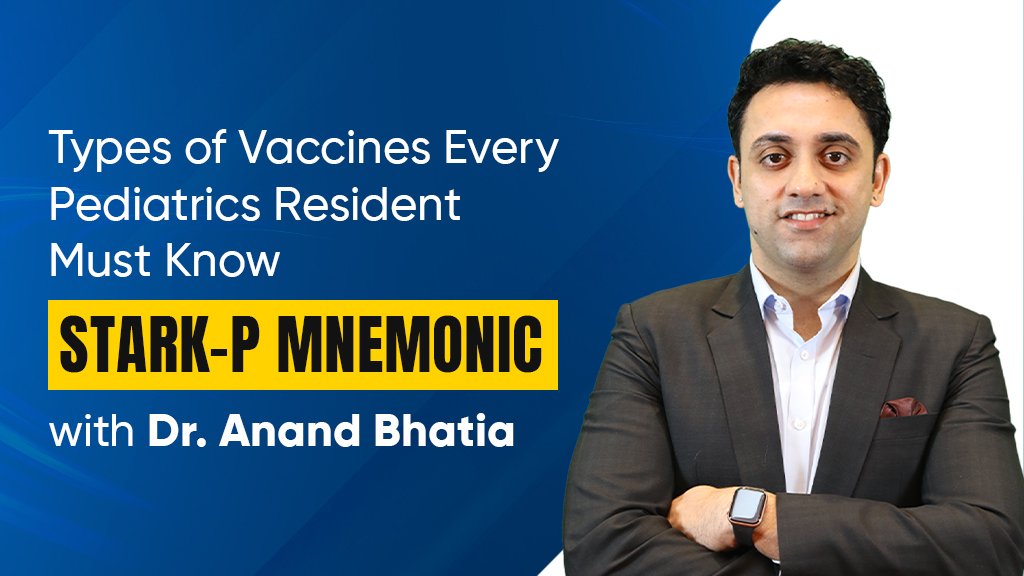
Conceptual Pediatrics brings you an important topic for your residency: Types of Vaccines, simplified with the STARK-P mnemonic.
The STARK-P Mnemonic
Remember:
S – Subunit vaccine T – Toxoid vaccine A – Attenuated live vaccine R – Recombinant vaccine K – Killed vaccine P – Polysaccharide vaccine
This one mnemonic can help you organize the major vaccine types and recall their important examples during revision.
1. Live Attenuated Vaccines
A live attenuated vaccine contains a live but weakened form of the organism. The organism is weakened enough to stimulate an immune response without causing the usual disease.
Important examples:
BCG
OPV
MMR
Varicella
Rotavirus
Yellow fever
Oral typhoid
For residency and exam preparation, remembering the common examples is essential.
2. Killed or Inactivated Vaccines
Here, the whole organism is killed or inactivated before it is used as a vaccine.
A common example is IPV – inactivated polio vaccine. Remember that IPV stands for inactivated polio vaccine, not injectable polio vaccine.
Other examples discussed include:
IPV
Rabies vaccine
Hepatitis A vaccine
Influenza vaccine
Whole-cell typhoid vaccine
DTP/DTwP as a whole-cell pertussis example
Killed vaccines cannot cause disease because the organism has been inactivated, although booster doses may be required to maintain immunity.
3. Subunit Vaccines
This is where the name itself gives you the clue.
A subunit vaccine does not contain the whole organism. Instead, it contains only a specific antigenic part of the organism, such as a protein or another component.
For example, the hepatitis B vaccine contains HBsAg, rather than the whole organism.
Examples include:
Hepatitis B
Acellular pertussis
Influenza split-subunit vaccine
One important point for revision:
Polysaccharide vaccines are a type of subunit vaccine, but not every subunit vaccine is a polysaccharide vaccine.
4. Toxoid Vaccines
Toxoid vaccines work differently. They contain an inactivated toxin (toxoid) produced by the organism rather than the live organism itself.
High-yield examples:
Tetanus toxoid
Diphtheria toxoid
This is a simple area, but it can easily become an MCQ point — so keep these two examples ready for quick recall.
5. Recombinant Vaccines
Recombinant vaccines are produced using recombinant DNA technology. They contain specific antigens produced through genetic engineering rather than the complete pathogen.
Examples discussed:
Hepatitis B vaccine — HBsAg
HPV vaccine — L1 protein
Novavax COVID-19 vaccine — spike protein
The key idea to remember is:
Recombinant vaccine = antigen produced using genetic engineering.
6. Polysaccharide Vaccines
Polysaccharide vaccines contain polysaccharide capsular antigens, which means they contain only a part of the organism.
They are considered a type of subunit vaccine and are T-cell independent.
Important exam point
Polysaccharide vaccines produce a poor immune response in children below 2 years of age. They also have a weak memory response and poor booster effect.
Therefore, in children under 2 years, conjugate vaccines are preferred over plain polysaccharide vaccines.
Examples mentioned include:
Typhoid polysaccharide vaccine
Meningococcal polysaccharide vaccine
Pneumococcal polysaccharide vaccine
The One-Line Revision Trick
If you’re revising this topic before an exam or a residency discussion, don’t try to memories every definition separately.
Just start with:
STARK-P
S → Subunit T → Toxoid A → Attenuated live R → Recombinant K → Killed P → Polysaccharide
Then attach 1–2 high-yield examples to each category.
Vaccine classification may look like a basic pediatrics topic, but it is exactly the kind of concept where small differences can become important during exams and clinical discussions.
Knowing whether a vaccine contains the whole organism, a specific antigen, an inactivated toxin or a polysaccharide can make the entire classification much easier to understand — instead of simply memorising a long list.
That is why having a quick mnemonic like STARK-P can make revision faster and more organised.
Learn More with Conceptual Pediatrics
This is just one of the many high-yield pediatrics topics that you need to keep revising during residency.
If you want more concept-based, exam-focused and residency-relevant pediatrics sessions, follow Conceptual Pediatrics and keep your preparation focused on the topics that actually matter.
Subscribe to Conceptual Pediatrics for more insightful sessions and ace your residency with stronger concepts.
Download the eConceptual App and subscribe to Conceptual Pediatrics today.