Managing Down Syndrome in Children By Dr Anand Bhatia

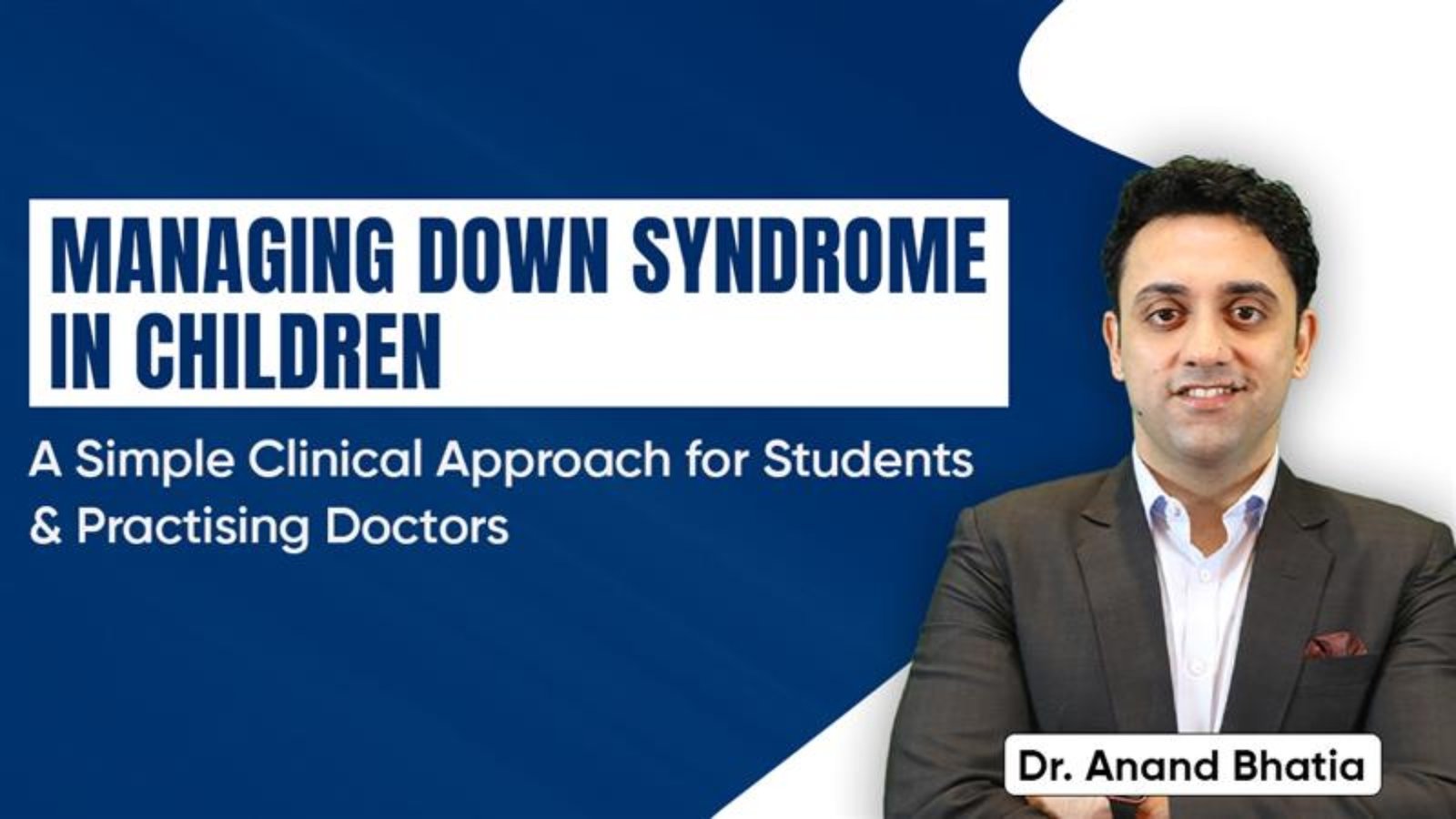
Managing Down Syndrome in Children: A Simple Clinical Approach for Students and Practising Doctors By Dr Anand Bhatia 

Down syndrome is one of the most commonly encountered chromosomal disorders in pediatric and obstetric practice. Every medical student, resident, and clinician must be comfortable with the screening, diagnosis, and clinical management. 

The approach to Down syndrome is not limited to just making the diagnosis. It involves proper antenatal screening, confirmatory testing, postnatal evaluation, and careful assessment before any surgical procedure. 

This article explains Down syndrome in a clear, practical, and exam-oriented manner. 

What is Down Syndrome? 

Down syndrome is a genetic condition caused by the presence of an extra copy of chromosome 21. This is known as Trisomy 21. 

Children with Down syndrome usually present with: 

  • Developmental delay 
  • Characteristic facial features 
  • Intellectual disability 
  • Reduced muscle tone (hypotonia) 
  • Multiple associated congenital anomalies 

One important point to remember is that Down syndrome is associated with hypotonia, not hypertonia. 

Antenatal Screening for Down Syndrome 

Screening during pregnancy helps identify pregnancies that have a higher risk of Down syndrome. 

First Trimester Screening (11–13 weeks) 

The main components are biochemical markers and ultrasound. 

Biochemical Markers 

In Down syndrome: 

  • Beta-hCG is increased 
  • Inhibin A is increased 
  • Alpha-fetoprotein (AFP) is reduced 

These markers form the basis of: 

  • Triple test – AFP, beta-hCG, estriol 
  • Quadruple test – AFP, beta-hCG, estriol, inhibin A 

AFP is the marker that is classically reduced in Down syndrome. 

Ultrasound Marker 

The most important ultrasound finding is: 

  • Increased nuchal translucency thickness (>3 mm) 

This is the most sensitive ultrasound marker for Trisomy 21. 

Diagnostic Tests for Down Syndrome 

Screening only gives probability. A definite diagnosis requires invasive testing. 

Chorionic Villus Sampling (CVS) 
  • Done between 11–13 weeks 
  • Sample taken from placenta (trophoblast) 
  • Can be done by: 
  • Transcervical route 
  • Transabdominal route 
Amniocentesis 
  • Done between 14–18 weeks 
  • Sample taken from amniotic fluid 
  • Only transabdominal route 
  • Cells studied: fibroblasts and amniocytes 
  • Considered safer than CVS 
Confirmatory Test: Karyotyping 

The final diagnosis of Down syndrome is made by karyotyping. 

After birth, blood is collected on a DBS (dried blood spot) card for chromosomal analysis. 

Karyotyping is mandatory in every suspected case. 

Clinical Features of Down Syndrome 

Common clinical findings include: 

  • Hypotonia 
  • Developmental delay 
  • Intellectual disability 
  • Characteristic facial features 
  • Feeding difficulty due to poor gut motility 
  • Single palmar crease (may be present but is not specific) 
Head Shape in Down Syndrome 

The most common skull shape is brachycephaly. 

This occurs due to early fusion of the coronal suture, leading to a short and broad head. 

Most Sensitive Ultrasound Marker of Trisomy 21 

The most sensitive ultrasound finding is: 
👉Increased nuchal translucency thickness (>3 mm) 

Other associated findings may include: 

  • Absent nasal bone 
  • Short femur 
  • Echogenic bowel 
Common Associated Anomalies 
Cardiac Defects 

The most common congenital heart disease in Down syndrome is: 
Endocardial cushion defect (AV canal defect) 

Every child with Down syndrome must undergo echocardiography. 

Gastrointestinal Defects 

Common gastrointestinal problems include: 

  • Duodenal atresia (double bubble sign) 
  • Hirschsprung disease 
  • Poor gut motility 
Preoperative Evaluation in Down Syndrome 

Before any surgery, the following must be assessed: 

  • Cardiac status (ECHO is mandatory) 
  • Airway anatomy 
  • Cervical spine stability 
  • Associated anomalies 

This ensures safe anesthesia and surgery. 

Conclusion: 

Down syndrome is a multisystem disorder that requires a structured and systematic approach. Early screening, confirmatory diagnosis, cardiac evaluation, and developmental support form the backbone of management. 

For students and residents, understanding these basics is essential not only for exams but also for day-to-day clinical practice. 

A clear concept today makes a confident doctor tomorrow. 

Share

Turner vs Noonan Syndrome By Dr. Anand Bhatia

Turner vs Noonan Syndrome: The Quick Clinical Differentiation done By Dr. Anand Bhatia Every Pediatrics Resident Should Know 

When preparing for pediatrics exams or clinical rounds, certain syndromes frequently create confusion. One classic example is Turner syndrome vs Noonan syndrome. Both conditions may present with similar physical features, especially webbed neck, which often leads to exam traps and diagnostic dilemmas. 

In one of his engaging teaching sessions, Dr. Anand Bhatia breaks down the key differences between these two syndromes in a simple and exam-oriented way. Let’s go through the most important clinical pearls you should remember. 

The Classic Exam Question: Webbed Neck 

A very common MCQ stem is: 

A patient presents with a webbed neck. What syndrome should you think of? 

The answer depends on the gender of the patient: 

  • Female with webbed neck → Turner syndrome 
  • Male with webbed neck → Noonan syndrome 

This quick clinical rule can immediately guide your thinking during exams. 

Turner Syndrome: Key Clinical Features 

Turner syndrome occurs due to a chromosomal abnormality with the karyotype 45,XO. It is seen only in females and has several characteristic clinical findings. 

Common Physical Features 

Patients typically present with: 

  • Short stature 
  • Webbed neck 
  • Widely spaced nipples (shield chest) 
  • Primary amenorrhea 
  • Underdeveloped ovaries (streak ovaries) 

Because the ovaries are nonfunctional, patients are infertile and cannot be biological parents. 

Hormonal Changes in Turner Syndrome 

Since the ovaries fail to function, the body attempts compensation: 

  • Increased FSH 
  • Increased LH 

This happens due to the brain attempting to stimulate the nonfunctional ovaries. 

Cardiac Associations 

Cardiovascular abnormalities are crucial exam points. 

Most common congenital heart disease 
  • Bicuspid aortic valve 
Most common cause of death 
  • Coarctation of the aorta 
X-Ray Finding in Coarctation 

A classic radiological sign: 

  • Figure-of-3 appearance 

This is a frequently tested MCQ. 

Renal Findings 

Patients with Turner syndrome often have renal abnormalities. 

The most important one: 

  • Horseshoe kidney 

Because of this, renal ultrasound is recommended during evaluation. 

Other Important Features 

Additional associations include: 

  • Hypothyroidism 
  • Lymphedema 
  • Cystic hygroma 
  • Sensorineural hearing loss 
  • Short fourth metacarpal 
  • High-arched palate 
Intelligence in Turner Syndrome 

Interestingly, unlike many genetic syndromes: 

  • IQ is usually normal in Turner syndrome 

This is an important differentiating point from many other syndromic conditions. 

Malignancy Risk 

A notable complication: 

  • Gonadoblastoma 

This occurs due to abnormal gonadal tissue. 

Noonan Syndrome: Key Features 

Noonan syndrome can affect both males and females, though it is often emphasized in exams in male patients with webbed neck. 

Unlike Turner syndrome: 

  • Karyotype is normal 
Clinical Characteristics 

Typical features include: 

  • Webbed neck 
  • Short stature 
  • Delayed puberty 
  • Intellectual disability (commonly present) 
Cardiac Association 

The most common heart defect seen in Noonan syndrome is: 

  • Pulmonary stenosis 
Facial Feature: Anti-Mongoloid Slant 

A distinguishing facial feature is: 

  • Downward slanting eyes (anti-mongoloid slant) 

For comparison: 

  • Upward slant → seen in Down syndrome 
  • Downward slant → seen in Noonan syndrome 
A Simple Mnemonic for Turner Syndrome 

Dr. Bhatia uses a helpful memory trick: “LOW CABINS.” 

This mnemonic captures multiple Turner features: 

  • L – Lymphedema / Low thyroid 
  • O – Ovaries underdeveloped 
  • W – Webbed neck 
  • C – Cystic hygroma 
  • A – Amenorrhea / Arch palate 
  • B – Bicuspid aortic valve 
  • I – (Implicit associations) 
  • N – Nipples widely spaced 
  • S – Short stature / Sensorineural hearing loss / Short 4th metacarpal 
Final Exam Pearl 

If you see the following combination in an MCQ: 

  • Female 
  • Webbed neck 
  • Short stature 
  • Widely spaced nipples 
  • Primary amenorrhea 

The answer is almost certainly Turner syndrome. 

Want to Learn Concepts Like This Faster? 

This explanation is just a small glimpse of the high-yield concepts discussed in depth inside the Conceptual Pediatrics learning platform. 

If you want clear mnemonics, exam-focused explanations, and clinically relevant teaching from experts like Dr. Anand Bhatia, explore the full sessions on the Conceptual Pediatrics app. 

Subscribe to Conceptual Pediatrics and ace your residency preparation with concept-based learning.  

Share

pg medical specialization

Pediatrics vs Orthopedics: Which Branch Should You Choose After NEET PG? 

Picking a specialty after NEET PG isn’t really about finding the “best” branch. It’s about figuring out which one actually fits you, your temperament, your interests, the kind of day-to-day work you can see yourself doing for the next few decades. 

MD Pediatrics and MS Orthopedics are two branches that pull in students for very different reasons. One is about caring for children as they grow, through illness, milestones, and everything in between. The other is about fixing what’s broken: bones, joints, ligaments, movement itself. 

So instead of asking “which branch is better,” a more useful question is: what kind of doctor do you actually want to become? 

Two Very Different Jobs 

Both specialties aim to make patients’ lives better, but the day-to-day work looks nothing alike. 

A pediatrician spends their time caring for newborns, infants, and adolescents diagnosing childhood illnesses, tracking growth and development, and doing a lot of preventive work like vaccinations and family counselling. 

An orthopedic surgeon deals with fractures, sports injuries, and joint problems. The work is hands-on and often surgical: reconstructive procedures, trauma fixation, correcting what’s not working so a patient can move properly again. 

Neither is “better” they just draw on different skills and put you in front of different patients. 

Who Are You Actually Talking To All Day? 

This is where the two branches really diverge. 

In pediatrics, you’re not just treating a child you’re constantly talking to worried parents too. Patience and clear communication end up mattering almost as much as your clinical knowledge. If you like building relationships over years, reassuring anxious families, and watching kids grow up under your care, this is where that shows up daily. 

In orthopedics, patients usually want one thing: to get back to normal as fast as possible. Someone with a fracture or a torn ligament isn’t looking for a long conversation — they want a fix. If you enjoy solving structural problems, working with your hands, and seeing visible, measurable improvement after a procedure, that’s the pull of ortho. 

What Residency Actually Looks Like?

Pediatrics residency puts you in NICUs and pediatric ICUs, emergency pediatric care, vaccination clinics, developmental screening, and managing everything from infections to chronic childhood conditions. 

Orthopedics residency means real time in the OT trauma surgeries, fracture fixations, joint replacements alongside outpatient clinics for musculoskeletal issues. 

A simple gut check: does a children’s ward excite you more, or an operation theatre? 

Where Each Path Can Take You?

After MD Pediatrics, you could work in a children’s hospital, join a government or private setup, start your own clinic, move into academics, or go on to super-specialize via DM in Neonatology, Pediatric Neurology, Pediatric Cardiology, or Pediatric Critical Care. 

After MS Orthopedics, options include multispecialty hospitals, building a trauma or orthopedic practice, sports medicine, academics, or fellowships in Arthroscopy, Spine Surgery, Joint Replacement, Hand Surgery, or Pediatric Orthopedics. 

Demand for both keeps growing as healthcare needs expand, so career security isn’t really the deciding factor here — fit is. 

Let Your Personality Weigh In Too 

Rank lists and forum debates can only tell you so much. Sometimes your own personality gives a clearer answer. 

You might lean toward pediatrics if you’re naturally patient, comfortable talking to families, drawn to preventive care, and motivated by relationships that last years rather than weeks. 

You might lean toward orthopedics if you’re practical, decisive under pressure, drawn to surgical work, and motivated by fixing something and seeing it work again. 

Before You Fill Your Final Choices 

A few honest questions worth sitting with: 

  • Do I actually enjoy treating children and dealing with their families? 
  • Am I more drawn to surgery than to medical management? 
  • Could I spend hours in an OT and still enjoy it? 
  • Which patients do I feel a real pull toward? 
  • Can I picture doing this work every single day, twenty years from now? 

These questions will usually tell you more than comparing salaries or closing ranks ever will. 

Final Thoughts 

Both Pediatrics and Orthopedics are solid, respected specialties with strong career prospects after NEET PG. There’s no universal right answer only the one that matches your interests and the kind of clinical work you want to spend your career doing. 

If guiding families, caring for their children, and managing all type of medical conditions feels very meaningful to you, although MD Pediatrics is worth serious consideration. If it’s about restoring the mobility, operating, and treating musculoskeletal problems is what excites you, MS Orthopedics might be the better fit. 

In the end, your specialty shouldn’t just reflect your NEET PG rank but it should reflect on the doctor that you actually want to become. A career which is chosen out of genuine interest will always beat one chosen because it looks good on paper. 

Share