When it comes to neonatal infections and congenital anomalies, few topics are as high-yield—and frequently tested—as the TORCH profile. Whether you’re preparing for exams or managing real clinical cases, understanding this panel is absolutely essential.
But here’s the problem: most residents memorize it… without truly understanding it.
Let’s fix that.
What is the TORCH Profile?
The TORCH profile is a group of infections that can be transmitted from mother to fetus, often leading to serious complications.
TORCH stands for:
T – Toxoplasmosis
O – Others (Syphilis, Varicella, Parvovirus B19, HIV, Hepatitis B)
R – Rubella
C – Cytomegalovirus (CMV)
H – Herpes Simplex Virus (HSV)
These infections are especially important because they can silently affect fetal development and present later with severe manifestations.
CMV → Most common congenital infection; periventricular calcifications
HSV → Severe neonatal sepsis-like presentation
Syphilis (Others) → Snuffles, rash, and bone involvement
These are frequently tested—don’t just memorize, understand the patterns.
Common Mistakes Residents Make
Let’s be honest—most mistakes happen because of:
Treating TORCH as a single test, not a clinical concept
Ignoring maternal history
Not correlating symptoms with timing
Relying only on reports instead of clinical reasoning
Avoid these, and you’ll already be ahead of most.
How to Approach TORCH in Clinical Practice?
A smart approach includes:
Detailed maternal history (fever, rash, infections during pregnancy)
Focused neonatal examination
Targeted investigations (not blind testing)
Correlation with imaging findings
👉 Always think clinically first, then confirm with tests.
Final Takeaway
The TORCH profile isn’t just a list—it’s a framework for thinking.
Mastering it will not only boost your exam performance but also make you more confident in managing real pediatric cases.
Want to Go Beyond Just the Basics?
What you just read is only a glimpse.
At Conceptual Pediatrics, we don’t just teach—you learn how to think like a pediatrician. From high-yield concepts to real clinical correlations, every session is designed to make your residency smoother and smarter.
👉 Download the eConceptual App today 👉 Explore Conceptual Pediatrics and make it your ultimate residency partner
Whether you choose the Solo plan or study smarter with the Buddy plan, you’ll unlock a whole new level of clarity.
In the NICU, time is often our most precious resource. Few conditions prove this more than Hypoxic Ischemic Encephalopathy (HIE). When a newborn is deprived of oxygen around the time of birth, the brain injury isn’t a single, static event. Instead, it’s an evolving process that unfolds over hours and days.
This is why neonatologists are so hyper-focused on the first six hours of life. In a recent teaching session, Prof. NB Mathur broke down the phases of HIE in a way that moves past the textbooks and into real-world clinical practice. Once you see the timeline, the “why” behind our treatments becomes crystal clear.
This phase happens within minutes of the hypoxic event. When oxygen and glucose levels plummet, the brain’s “power plants” fail.
Without enough ATP (energy), the cellular pumps that maintain balance stop working. Sodium and calcium flood into the cells, causing them to swell. The chemical chain reaction looks something like this:
As this is happening, several fires start at once: lactate levels rise, glutamate is released, and oxidative stress begins. While some neurons die immediately, many others are “stunned”—damaged but still salvageable if we act fast.
2. The Latent Phase: Our “Golden Window”
After the initial crisis, there is often a deceptive period of calm called the Latent Phase, usually lasting between 1 to 6 hours.
During this time:
Resuscitation has stabilized the baby’s circulation.
Oxygen supply has partially returned.
ATP production temporarily ticks back up.
Clinically, this phase can be a “trap.” The baby might look relatively stable, leading to a false sense of security. But under the surface, the injury is quietly simmering. Calcium overload and mitochondrial dysfunction are still active.
This is the most critical window in HIE management. Therapeutic hypothermia (cooling) is most effective during these first six hours. For residents, remembering this window is the difference between reactive and proactive care.
3. Secondary Energy Failure: The Second Wave
Starting around the 6-hour mark and lasting up to 48 hours, the Secondary Phase (or reperfusion injury) begins.
It sounds counterintuitive—why does the brain get worse once blood flow returns?
Even with oxygen available, the damaged mitochondria can’t use it. Inflammatory “alarms” (cytokines like TNF-alpha and IL-6) go off, further damaging neurons and the brain’s white matter. This is when the most significant, permanent neuronal loss often occurs.
4. The Tertiary Phase: The Long Road to Recovery
The Tertiary Phase begins weeks after the initial event and can last for months. This is a complex period where the brain is simultaneously dealing with chronic inflammation and trying to repair itself.
While the damage may continue, the brain also shows incredible plasticity. Through neurogenesis and remodeling, the brain attempts to rewire. This is why long-term developmental follow-up is non-negotiable; we aren’t just treating a baby in the NICU, we are managing their potential for the rest of their life.
Why This Matters for Residents?
HIE can feel like an overwhelming mountain of pathways and terminology. But when you look at it as a timeline, it becomes a clinical map.
You start to see why the “Golden Six Hours” isn’t just a catchphrase—it’s the only time we have to truly change the trajectory of the injury. When you understand these phases, HIE stops being a topic you memorize for rounds and starts being something you can actually visualize at the bedside.
Want to get deeper into clinical pediatrics?
If you found this helpful, the Conceptual Pediatrics App offers many more high-yield sessions designed specifically for residents. From NICU protocols to emergency cases, we focus on simplifying the complex so you can focus on your patients.
You can’t rely only on memorizing one-liners because many questions are built around clinical reasoning. A child presenting fever, rash, hypotonia, or developmental delay can lead to multiple possibilities, and the exam often tests whether you can connect concepts quickly.
That’s where many students struggle during revision.
They remember isolated facts but get confused when questions become case based.
This is why conceptual learning becomes extremely valuable in the final phase of DNB preparation.
Platforms like Conceptual Pediatrics are becoming increasingly useful for aspirants because they focus on integrated understanding instead of plain memorization.
And during the last month, practicality matters more than collecting ten different resources.
What Should You Actually Focus on in the Last Month?
Not every topic deserves equal time now.
The smarter approach is to identify areas that repeatedly appear in exams and revise them aggressively.
Topics that usually need repeated revision include:
Neonatology
Growth and development
Vaccination schedules
Pediatric infectious diseases
Inborn errors of metabolism
Fluid and electrolyte management
Genetics and syndromes
Pediatric emergencies
These areas are highly volatile. If you don’t revise them repeatedly, details start fading very quickly.
And Pediatrics is a subject where small details often change the answer completely.
MCQ Practice Matters More Than Passive Reading
One mistake many students make during DNB Pediatrics preparation is spending the entire day reading theory without testing themselves.
That’s why daily MCQ practice has become essential in the last month.
Not just for speed, but for pattern recognition.
Good MCQ practice helps you:
Identify commonly repeated concepts
Improve elimination skills
Understand clinical framing
Build decision-making under pressure
More importantly, it exposes weak areas early enough to fix them.
Stop Chasing Perfect Notes
This phase is not about making aesthetic notes or organizing folders.
If you’re still rewriting entire subjects during the final month, you’re probably wasting valuable revision time.
Short notes should only serve one purpose now: rapid recall.
Focus on:
Difficult tables
Frequently confused topics
High-yield classifications
Image-based points
Previous mistakes
That’s enough.
Overloading yourself with excessive material usually increases anxiety rather than confidence.
Your Revision Style Matters Too
Some students revise passively for hours and still struggle to retain information.
Others revise for shorter periods but actively test themselves, discuss cases mentally, and solve questions alongside revision. Their retention is usually much stronger.
Pediatrics especially rewards active learning because the subject is deeply clinical.
Instead of simply reading “causes of metabolic acidosis,” ask yourself:
Which condition presents earliest?
Which investigation confirms it?
What’s the first-line management?
That small shift makes revision much more effective.
The Last Week Before DNB Pediatrics
The final few days can become mentally draining if you’re not careful.
This is when panic revision usually begins.
Students start downloading extra PDFs, comparing preparation levels, and trying to cover untouched topics overnight. It creates unnecessary stress and usually harms recall.
The last week should actually feel lighter.
Your focus should stay on:
Rapid revision
Clinical images
Vaccines and milestones
High-yield MCQs
Previous incorrect questions
Volatile facts
And yes, proper sleep matters more than most aspirants admit.
A tired brain struggles with recall, especially in long clinical exams.
Can One Month Really Make a Difference?
Definitely.
A focused month of revision can improve performance far more than scattered preparation over several months.
Many rank improvements happen in the final stretch because students finally become disciplined with revision and testing.
Not because they suddenly study 18 hours a day.
The students who perform well usually do three things consistently:
Revise repeatedly
Practice questions daily
Stay calm under pressure
That combination works surprisingly well.
Final Thoughts
DNB Pediatrics preparation in the last month doesn’t need to feel chaotic.
You do not have to complete every resource or memorize every line to score well. What matters more is how effectively you revise what already matters.
Keep your preparation simple, and most importantly, trust your revision process.
Because in Pediatrics, clear concepts and repeated recall almost always outperform last-minute cramming.
If you’ve spent time on the wards, you know the feeling. You read about something in a textbook, nod along, think you’ve got it and then a real patient shows up and suddenly nothing feels as clear-cut as it did on the page. 0
Pediatric oncology emergencies are exactly that kind of topic.
I recently sat through an academic session that tackled this subject using actual patient cases instead of the usual slide decks crammed with definitions. Honestly, it made all the difference. Watching how clinical findings, lab results, and emergency decisions connected in real time helped things click in a way that passive reading never quite does.
These are the sessions that push you to think like a clinician, not just someone cramming for an exam.
A Child with Fever, Pallor, and Something More
The case that kicked off the discussion involved a four-year-old boy. His parents brought him in with fever, worsening pallor, and tiny red spots scattered across his skin. They’d also noticed he seemed to be breathing faster than normal.
On the surface, these complaints might seem like separate issues. But once you start examining the child, the pieces begin falling into place.
He had lymph nodes palpable all over, an enlarged liver and spleen, striking pallor, and tenderness when you pressed on his bones. If you’ve worked in pediatrics for any length of time, your mind immediately jumps to something hematological—and something serious.
The labs backed that up. Severe anemia. A sky-high white cell count. Platelets in the gutter. And blasts on the peripheral smear.
Bone marrow confirmed it: Acute Lymphoblastic Leukemia.
But here’s the thing—the diagnosis wasn’t the only problem we needed to worry about.
When the Diagnosis Isn’t the Only Emergency
This was one of the session’s most valuable lessons. Sometimes what’s going to hurt the child first isn’t the cancer itself.
In this case, the boy’s bloodwork revealed a pattern that should make any resident sit up straight:
Uric acid through the roof
Phosphate climbing
Potassium dangerously elevated
Calcium dropping
That’s Tumor Lysis Syndrome. It happens when malignant cells—especially in cancers with rapid turnover—break apart and dump their contents into the bloodstream faster than the body can clear them.
On paper, it sounds like a lab problem. In reality, it can spiral into kidney failure, cardiac arrhythmias, and severe metabolic chaos before you know what hit you.
This is why TLS gets its own category as a true pediatric oncology emergency. Miss it, and you’re in trouble.
The Takeaway: Stabilize First
One point the faculty hammered home was simple but easy to forget in the heat of the moment: stabilize before you treat the cancer.
You don’t rush into chemotherapy while a child’s electrolytes are a mess. Hydration comes first—aggressive, careful hydration. You watch the urine output like a hawk. You track electrolytes, kidney function, and counts obsessively.
Something else came up that stuck with me. The faculty mentioned how certain interventions that were standard practice a few years ago aren’t routinely recommended anymore. Medicine moves fast, and what you learned in medical school might already be outdated by the time you’re a second-year resident.
It’s a humbling reminder to keep checking your assumptions against current evidence.
Another Emergency That Residents Must Recognize
The session then shifted gears—from metabolic emergencies to structural ones.
A tumor growing inside the chest creates an entirely different set of problems. When a mediastinal mass or bulky lymph nodes start compressing major vessels and airways, children can present with:
Swelling of the face
Prominent, distended neck veins
Difficulty breathing or respiratory distress
Redness or swelling around the eyes
An overall appearance of being “congested” from the neck up
These findings should immediately raise a red flag. Conditions like Non-Hodgkin Lymphoma, Hodgkin Lymphoma, and certain germ cell tumors can compress the superior vena cava, leading to Superior Vena Cava Syndrome.
This isn’t something that can wait. Recognizing these warning signs early—and acting on them—can genuinely change outcomes.
Why Sessions Like These Matter?
Here’s the truth: you can spend hours reading oncology chapters and still feel lost when a real case walks through the door.
What makes the difference is watching someone walk you through the thinking. Why did they order that test? What made them suspect this diagnosis over that one? How did they prioritize when multiple things were going wrong at once?
That’s what made this session valuable. It wasn’t a lecture about pediatric oncology emergencies. It was a window into how experienced clinicians actually approach them.
Instead of memorizing isolated facts, you start to understand the logic underneath—and that’s what sticks.
Learning Beyond Notes and Textbooks
Sessions like this are regularly available on Conceptual Pediatrics, a platform built specifically for pediatric residents.
What sets it apart from generic medical education sites is the focus. The content is designed around what pediatrics residents actually struggle with case-based learning, high-yield exam topics, clinical reasoning, and practical ward knowledge. Whether you’re prepping for case presentations, theory exams, or entrance tests, the material tends to fill gaps that standard textbooks leave open.
For anyone in pediatric training looking to sharpen their clinical thinking, it’s worth exploring.
Final Thoughts
Pediatric oncology emergencies can feel overwhelming, especially early in residency. But they become a lot less intimidating once you understand the clinical clues, know which red flags matter, and have a clear framework for what to do first.
Sessions that ground complex topics in real cases—real decisions, real consequences—help bridge that uncomfortable gap between reading about something and actually managing it.
And for those of us still building that clinical instinct, resources that prioritize this kind of focused, scenario-based learning make a real difference.
Lets begin with MD Pediatrics residency is huge. You’re excited but also asking yourself a million questions. What’s residency actually like? How do you handle each year? When do you focus on procedures versus research? What is the career path after this?
You know what that MD Pediatrics is more than a degree. It’s three years of learning clinical skills, getting confident, doing critical research, and building the foundation for a career working with kids.
This is for residents starting in 2026. What residency looks like. How to make the most of each year. Career options, lifestyle, salary, all of it.
Why MD Pediatrics Is Still a Solid Choice?
Pediatrics works because it’s medicine plus prevention, long-term relationships with patients, and getting to influence health from the beginning of life.
Most specialties just treat disease. Pediatricians do that, but also growth monitoring, developmental checks, vaccinations, nutrition, neonatal care, emergencies, chronic disease management.
India’s healthcare is expanding. Hospitals need good pediatricians. Government hospitals, private institutions, NICUs, children’s hospitals, community centers. All hiring.
That means after residency you don’t have one path. You have options.
What Residency Actually Feels Like?
You expect long hours. That part’s true. But residency is way more than that.
It involves:
Emergency duties
Ward rounds
NICU and PICU postings
Outpatient departments
Neonatal resuscitation
Academic seminars
Journal clubs
Case presentations
Thesis work
Practical procedures
Continuous bedside learning
The first few months? Overwhelming. Everything’s new. But confidence builds with every patient, every procedure, every decision you make under someone watching.
Residency isn’t a race to know everything immediately. It’s a gradual learning process.
First year is where you develop the skills for everything that comes after.
Don’t worry about reading every textbook cover to cover. Focus on practical competence alongside understanding.
Choosing the Right Thesis
This matters more than people think. A good thesis topic makes research actually manageable over three years. Pick something you’re genuinely interested in. Something your department supports. Something realistic to finish.
Your thesis isn’t just a requirement. It’s your first real exposure to clinical research.
Learn Every Basic Procedure
First year is all about hands-on skills.
You gradually get comfortable with:
IV cannulation
Blood sampling
Blood transfusion monitoring
ECG interpretation
Ventilator settings
Monitoring vital parameters
Basic neonatal and pediatric emergency procedures
These seem scary at first. With practice and supervision, they become automatic.
Don’t avoid procedures because you’re afraid of messing up. Actively seek supervised opportunities to practice.
Strengthen Your Concepts Every Day
Clinical work teaches you how to manage patients. Books teach you why you’re doing it.
Do both together. That’s how you become confident.
Study after rounds. Study during quieter duty hours. Study after discussing cases with seniors. Make it part of your day.
Second-Year Residents: Actually Understand What You’re Doing
By second year, ward work feels normal.
Now it’s time to go deeper. Stop just memorizing management protocols. Start understanding why you do every investigation, every treatment choice, every clinical decision.
Second-year priorities:
Work through the academic syllabus systematically
Build clinical reasoning
Keep working on your thesis
Solve previous university exam questions
Get better at case presentations
Get confident with emergency situations
Study by topic, not sequentially through textbooks. You’re seeing common pediatric conditions in postings. Use those experiences to reinforce what you’re learning while it’s fresh.
Third-Year Residents: Getting Ready to Work Independently
Third year is where everything comes together.
You shift from learning under supervision to working more independently.
Focus on:
Finishing your thesis
Preparing for university exams
Managing complex cases confidently
Teaching junior residents
Revising important topics
Getting procedures down
Teaching junior residents is one of the best ways to actually retain knowledge. Explaining cases, discussing management, participating in teaching sessions strengthens your own understanding.
By the time you’re teaching first-years, you’ll realize how much you’ve actually learned over three years.
Career Options After MD Pediatrics
This is the best part about Pediatrics. You’ve got real options.
Clinical Practice
Work in:
Corporate hospitals
Multispecialty hospitals
Children’s hospitals
Government medical colleges
District hospitals
Super-Specialization
Pursue DM or fellowship programs in:
Neonatology
Pediatric Cardiology
Pediatric Neurology
Pediatric Critical Care
Pediatric Gastroenterology
Pediatric Nephrology
Pediatric Endocrinology
Pediatric Hematology-Oncology
Pediatric Pulmonology
Teaching
Medical colleges hire pediatricians for teaching while continuing clinical work.
Research
Strong researchers during thesis often continue into clinical research, multicenter trials, public health, academic publications.
Private Practice
Many pediatricians build their own clinics. Takes time and community trust, but it works for people who want that independence.
Salary After MD Pediatrics
Depends on:
City
Hospital type
Government or private sector
Experience
Additional fellowships
Super-specialization
Fresh graduates get competitive starting salaries. Growth happens as you get experience.
Pediatricians with fellowships, jobs at tertiary care hospitals, or successful private practices make significantly more over time.
Don’t just think about starting salary. Think about long-term growth, specialization, professional development.
Skills That Actually Matter
Knowledge alone isn’t enough.
Good residents also develop:
Communication with parents
Clinical decision-making
Emergency management
Teamwork
Time management
Documentation skills
Research methodology
Teaching ability
Compassion and patience
These skills determine how confidently you work independently after residency.
Making the Most of Residency
You’ll have exhausting moments. Doubt yourself. Feel uncertain. That’s normal.
The goal isn’t perfection in year one. It’s getting better consistently over three years.
Here’s what works:
First year: Build procedural skills. Choose your thesis carefully. Nail core pediatric concepts.
Second year: Deepen your understanding of why things work. Get through your syllabus topic by topic. Stay consistent with research.
Third year: Finish your thesis. Study comprehensively. Teach juniors. Get ready to work independently.
Consistent small progress beats trying to be perfect.
Final Thoughts
MD Pediatrics is three years of continuous learning. Every year brings different responsibilities. The basic procedures and thesis selection in year one. The Complex cases and mentoring in year three.
The goal isn’t knowing everything on day one. It’s improving consistently through experience and studying.
By the end you’ll have the skills, confidence, and knowledge to work in hospitals, academics, research, super-specialization, or private practice.
Make the most of every posting, every patient, every learning opportunity. The habits you build during residency become who you are as a pediatrician.
Vaccines are one of those topics that keep coming back during residency – whether you’re preparing for an exam, revising pediatrics, or trying to quickly recall an important concept during clinical discussions.
And when there are multiple vaccine types and their examples to remember, a simple mnemonic can make revision much easier.
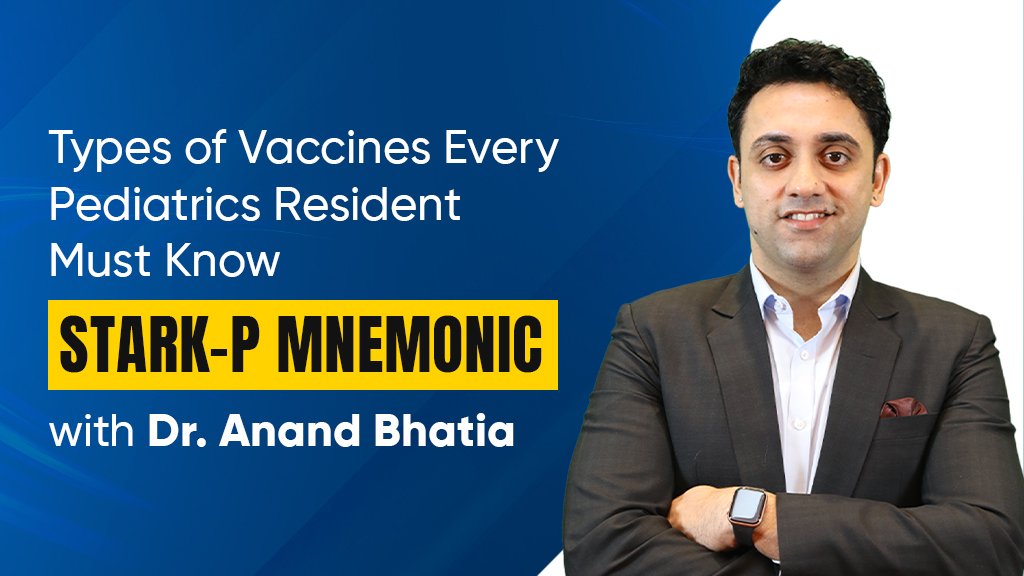
Conceptual Pediatrics brings you an important topic for your residency: Types of Vaccines, simplified with the STARK-P mnemonic.
The STARK-P Mnemonic
Remember:
S – Subunit vaccine T – Toxoid vaccine A – Attenuated live vaccine R – Recombinant vaccine K – Killed vaccine P – Polysaccharide vaccine
This one mnemonic can help you organize the major vaccine types and recall their important examples during revision.
1. Live Attenuated Vaccines
A live attenuated vaccine contains a live but weakened form of the organism. The organism is weakened enough to stimulate an immune response without causing the usual disease.
Important examples:
BCG
OPV
MMR
Varicella
Rotavirus
Yellow fever
Oral typhoid
For residency and exam preparation, remembering the common examples is essential.
2. Killed or Inactivated Vaccines
Here, the whole organism is killed or inactivated before it is used as a vaccine.
A common example is IPV – inactivated polio vaccine. Remember that IPV stands for inactivated polio vaccine, not injectable polio vaccine.
Other examples discussed include:
IPV
Rabies vaccine
Hepatitis A vaccine
Influenza vaccine
Whole-cell typhoid vaccine
DTP/DTwP as a whole-cell pertussis example
Killed vaccines cannot cause disease because the organism has been inactivated, although booster doses may be required to maintain immunity.
3. Subunit Vaccines
This is where the name itself gives you the clue.
A subunit vaccine does not contain the whole organism. Instead, it contains only a specific antigenic part of the organism, such as a protein or another component.
For example, the hepatitis B vaccine contains HBsAg, rather than the whole organism.
Examples include:
Hepatitis B
Acellular pertussis
Influenza split-subunit vaccine
One important point for revision:
Polysaccharide vaccines are a type of subunit vaccine, but not every subunit vaccine is a polysaccharide vaccine.
4. Toxoid Vaccines
Toxoid vaccines work differently. They contain an inactivated toxin (toxoid) produced by the organism rather than the live organism itself.
High-yield examples:
Tetanus toxoid
Diphtheria toxoid
This is a simple area, but it can easily become an MCQ point — so keep these two examples ready for quick recall.
5. Recombinant Vaccines
Recombinant vaccines are produced using recombinant DNA technology. They contain specific antigens produced through genetic engineering rather than the complete pathogen.
Examples discussed:
Hepatitis B vaccine — HBsAg
HPV vaccine — L1 protein
Novavax COVID-19 vaccine — spike protein
The key idea to remember is:
Recombinant vaccine = antigen produced using genetic engineering.
6. Polysaccharide Vaccines
Polysaccharide vaccines contain polysaccharide capsular antigens, which means they contain only a part of the organism.
They are considered a type of subunit vaccine and are T-cell independent.
Important exam point
Polysaccharide vaccines produce a poor immune response in children below 2 years of age. They also have a weak memory response and poor booster effect.
Therefore, in children under 2 years, conjugate vaccines are preferred over plain polysaccharide vaccines.
Examples mentioned include:
Typhoid polysaccharide vaccine
Meningococcal polysaccharide vaccine
Pneumococcal polysaccharide vaccine
The One-Line Revision Trick
If you’re revising this topic before an exam or a residency discussion, don’t try to memories every definition separately.
Just start with:
STARK-P
S → Subunit T → Toxoid A → Attenuated live R → Recombinant K → Killed P → Polysaccharide
Then attach 1–2 high-yield examples to each category.
Vaccine classification may look like a basic pediatrics topic, but it is exactly the kind of concept where small differences can become important during exams and clinical discussions.
Knowing whether a vaccine contains the whole organism, a specific antigen, an inactivated toxin or a polysaccharide can make the entire classification much easier to understand — instead of simply memorising a long list.
That is why having a quick mnemonic like STARK-P can make revision faster and more organised.
Learn More with Conceptual Pediatrics
This is just one of the many high-yield pediatrics topics that you need to keep revising during residency.
If you want more concept-based, exam-focused and residency-relevant pediatrics sessions, follow Conceptual Pediatrics and keep your preparation focused on the topics that actually matter.
Subscribe to Conceptual Pediatrics for more insightful sessions and ace your residency with stronger concepts.
Download the eConceptual App and subscribe to Conceptual Pediatrics today.